
Where are the key levers in the construction industry?
Alongside the processes on site at the construction site, the planning of construction sequences is a central point. Keeping an overview of various projects together with their employees and the corresponding inventory resources - often with project delays caused by dependencies on preceding trades, material shortages or bad weather - and coordinating them successfully can become a real challenge. Precisely in view of the given conditions in the construction industry, however, it is important to be able to rely on effective planning of both employees and inventory - and at this point not merely to avoid losses but to be able to increase productivity effectively.
What should good deployment planning be able to do?
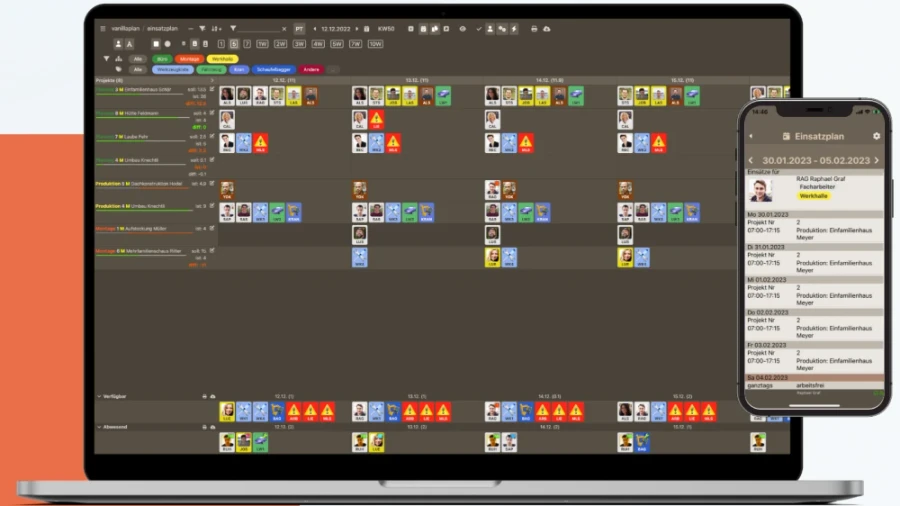
Fundamentally, the task of deployment planning is to dispatch the required employees and inventory to the right place at the right time in order to make workflows maximally efficient. Compared with analogue or Excel-based planning tools, digital solutions offer the advantage that all projects with employees and inventory are clearly displayed in one central tool, possible changes are easy to insert and the rest of the planning adjusts automatically. It is visible to everyone when and where which employees, machines and vehicles are, which means planning certainty exists at an early stage and agreements with everyone involved are made easier. In this way idle time or overstaffing on the construction site ultimately become rare and company utilisation and productivity can be increased.
How the Vanillaplan software can support you with your deployment planning is what we would like to go into in the following articles. In them we will show which tricks and possible uses our customers employ in order to use the software ideally tailored to their needs.