
National Future Day: choosing a career regardless of gender
Spending a day trying out, with an open mind, a profession that is untypical for your own gender: that is the idea behind tackling this gender inequality in working life. That is why National Future Day takes place in Switzerland today. For one day, boys and girls in grades five to seven can gather impressions and experience in a profession untypical for their gender and get to know new fields of work.
The aim is to promote equality between men and women and an individual career choice free of gender stereotypes from an early age. While girls mainly try out professions in IT, construction and technology, boys spend the day looking at work in care or healthcare professions, for example.
Women in construction trades: insights from practice
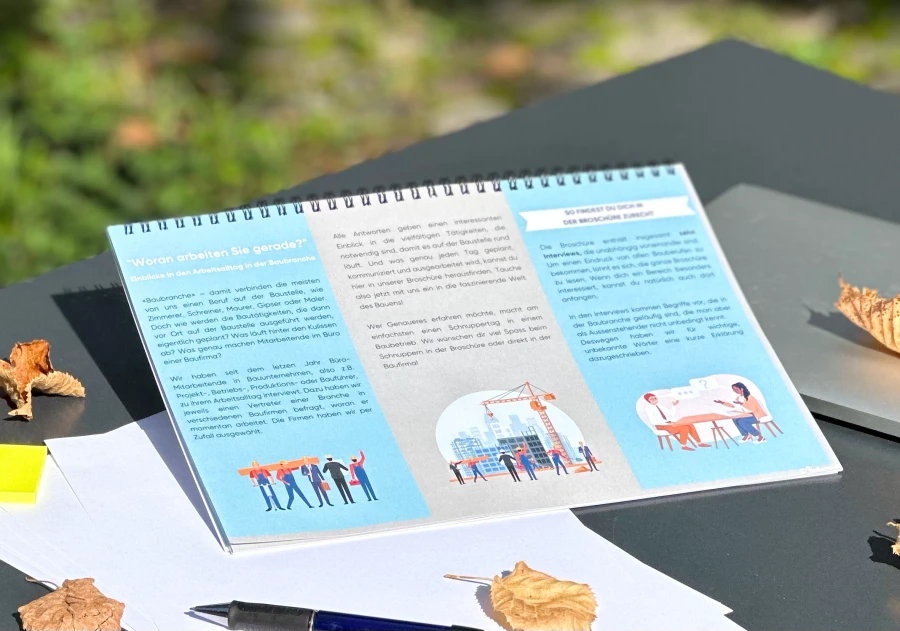
We at Vanillaplan want to take today's Future Day as an occasion to look at the work of women in construction. To this end, we interviewed senior staff from various construction sectors about the importance of women in this field. We also asked women working in the construction industry about their everyday work, as well as about possible difficulties and obstacles in a male-dominated working environment. Here are a few insights from these interviews.
Women in construction trades: still the exception
The consensus is that in most construction sectors women are unfortunately still the exception rather than the rule, but would be both needed and very welcome.
Women in road construction and bricklaying
A road builder tells us that women are very rarely found at his company, which he finds a great pity, especially since the woman who previously worked there did, on average, even better work than the men. He can understand, however, why women do not feel comfortable among so many men.
He does not know how this situation can be changed, but today's working conditions would actually no longer be a problem for women either, since much is mechanised and, for example, there is no longer as much heavy lifting as there used to be.
A bricklaying foreman, on the other hand, points out that the bricklayer's trade is certainly strenuous and more difficult for women. Nevertheless, every woman would be more than welcome, and he would like to see the cliché of bricklaying as a man's job done away with. In his estimation there are now more women than before, but still too few.
Women in gardening and landscaping
An apprentice gardener tells us that although only two women work at her current workplace, there are roughly as many women as men in training. Asked how she came to the landscaping trade, she says she grew up on a farm and so already had a certain connection to the profession. A holiday job and taster days later confirmed her interest in this field.
She does not feel that there is a barrier for women in gardening.
Women in the tinsmith's trade
On the subject of women in the tinsmith's trade, an apprentice tinsmith tells us that she is the only woman training as a tinsmith in all of Basel-Landschaft and Basel-Stadt. When she was choosing her career, she was advised from all sides to go to grammar school rather than do an apprenticeship. In the end she opted for the tinsmith's trade after all, but thinks it is very good to be doing the vocational baccalaureate alongside it.
From her personal experience as a woman in the trade, she tells us that she is often approached about it, but always in a positive context. Overall she sees few obstacles and hurdles: in the tinsmith's trade in particular, working conditions for a woman are very good, because the focus is not on heavy but rather on creative work.
A carpenter's experience in the building trades
Asked how she came to her profession, a carpenter tells us that she once went on a taster placement on a whim, because she did not want to go to grammar school. After that she could imagine going in this direction professionally. Regarding her search for an apprenticeship, we learn that she looked at various companies, but that there were also some that did not take women or were not very open to the idea. She was very happy with the apprenticeship she eventually got, though.
The fact that she works as a woman in carpentry has, by her account, often been a topic. She says she can work well with some people, whereas with others she first had to learn how to deal with them, avoid them or confront them. While it was still difficult during her apprenticeship, she now has enough self-confidence to handle it.
How young women view construction trades today
At the careers fair in Liestal at the end of October, where various companies and associations presented their fields of work to young people, we interviewed two girls we met at the joiners' stand about their career wishes. While one of them was already sure she wanted to go into a medical field, the other was interested in the joiner's trade. She likes it because she enjoys working with wood.
She did not think that the joiner's trade was more difficult or unusual for girls and women than for boys, especially as there had been just as many girls as boys at the joiners' stand.
How construction trades can become more attractive to women
It remains to be hoped that the image of construction as a typically male domain will change little by little among the younger generations. Advancing mechanisation, which makes work in the construction industry less physically strenuous, a women-friendly company culture from the start of the apprenticeship, and offerings such as Future Day, through which girls realise early on that a career can be chosen regardless of gender, will certainly help.
Women as potential against the shortage of skilled workers
The importance of girls and women for construction becomes particularly relevant in view of the shortage of young people in the construction trades that many mention. By specifically addressing young women, construction companies may find a way here to fill their gaps in the next generation more effectively.