
Ernst Fink AG – the company
From the founding to today
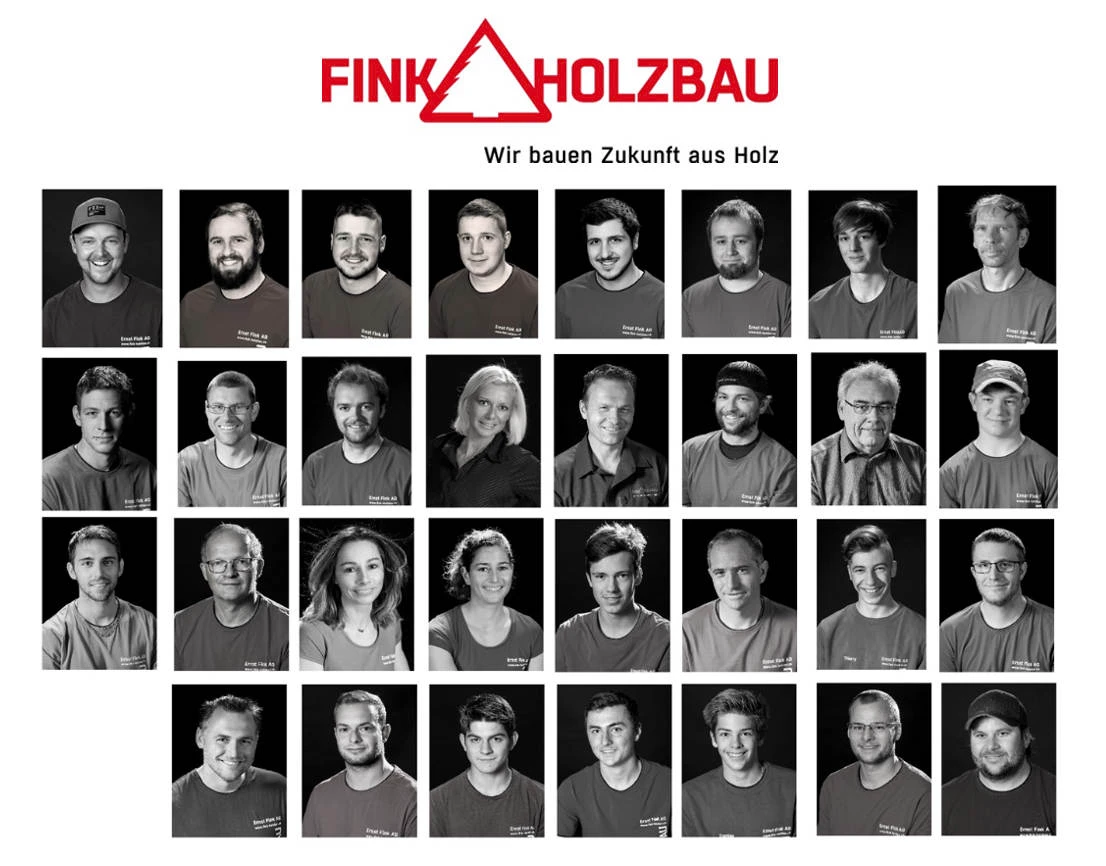
The company Fink Holzbau und Sägerei was founded in 1932 by Alfred Fink. In the 1970s it was continued by the brothers Ernst and Hans. In the 1990s the general partnership was converted into Ernst Fink AG. Since 2016 the current owner, Bruno Fink, has successfully run the company in the third generation and has expanded the timber construction and contract work divisions. The company employs around 30 people.
From wood, a natural and renewable raw material, Ernst Fink AG creates individual, tailor-made solutions for private individuals, agriculture, trade and the public sector.
Timber construction and services as two pillars
The strength of Ernst Fink AG rests on two pillars:
Fink Holzbau, the core business, for building roof structures, timber facades, conversions and interior fit-outs, and Fink Services, the secondary business, with two joinery machines for processing timber from single beams to panels.
Advice, quality and individual solutions
Successful timber construction rests on several qualities. The dedicated employees advise their customers competently, so that individual ideas turn into uniquely designed, carefully built and beautiful roof structures in local timber for new builds and conversions.
Customers of Ernst Fink AG appreciate that, on the one hand, everything comes from a single source, from the first sketch to the finished structure, and, on the other, they benefit from many years of experience combined with a strong spirit of innovation in demanding special constructions.
Interview with Jakob Strähl
Jakob Strähl began his fascination with wood with an apprenticeship at Ernst Fink AG in 2003. He went on to train as a timber construction foreman and still successfully runs the operation today.
Mr Strähl, what was the highlight of the past year?
We had a coronavirus-free year and enough work for all our employees.
Where did you learn resource planning?
I learned resource planning in the business. A little in the military, and the theory during my training as a timber construction foreman.
How did you learn deployment and capacity planning?
You have to have a feel for deployment and capacity planning and know all the jobs and processes, so that you know how to coordinate and optimise them. The more knowledge you have, the better everything can be timed to fit together.
Is there further training in this field too?
Holzbau Schweiz offers such courses. I have attended some of them. The most interesting part of these courses is the exchange with other users.
How did you hear about Vanillaplan?
The software was recommended to me by az Holz AG.
How did you do resource planning before Vanillaplan?
We had an Excel spreadsheet for deployment planning, and a lot was simply in our heads. Capacity planning was done from experience. In the past we accepted an order and had three months until execution. Today things move faster. We accept an order and it should already have been finished yesterday. So we have to become more flexible.
How did getting started with Vanillaplan go?
Getting started went well. As I say, you never stop learning. The software is simply structured and you keep learning as you use it.
What were the challenges?
It was nice to learn something new. For us it was a tool that makes sense. The rest was diligent work.
Who is responsible for resource planning?
Only I and my deputy, when I am away, work with the software. The project managers only have viewing access. The reason is that I have the most experience and have timed everything very precisely. The more cleanly Vanillaplan is kept, the easier it gets. I record every movement in it. Diligence is part of it.
How are capacity and deployment planning organised in your business?
Every Thursday we discuss the weekly plan with all the project managers. Before coronavirus we all went to lunch together beforehand, and the information from those conversations then flowed into the planning. Back then we printed the weekly plan on paper and discussed it.
Since coronavirus I present the weekly plan directly on screen. Everyone sees what I have planned. That is an advantage. It has also become more efficient directly on screen.
Early in the morning I record employees who have called in sick or have to go into quarantine, the fine-tuning. Since coronavirus we have had fewer changes and shifts in the teams. That makes planning simpler and more efficient. Acceptance among customers has also increased.
What do you like about Vanillaplan?
The capacity plan, the weekly plan and the long-term plan are the best.
What is your benefit?
We have become much more agile and have a far better overview than before. We invested in Vanillaplan to gain certainty.
Many thanks for the interview, Mr Strähl.
More information on the Fink Holzbau website.