
Berchtold Küchen – the company
Since Berchtold Küchen was founded, the company philosophy has always remained the same. It consists of two principles. The customer is king: personal, individual advice to each customer is at the heart of everything, from the first consultation to the handover of the finished kitchen. And: there is no such thing as impossible – individual customer wishes and challenges are realised by competent and reliable employees with great expertise, creativity and passion.
This philosophy is applied to all services: in a complete kitchen build, where individual solutions, the best possible use of space with sufficient storage, functionality and an optimal mix of materials come first, but also when replacing kitchen appliances or producing joinery work of any kind.
Customers of Berchtold Küchen appreciate that everything comes from a single source, and is always created with great passion: from the first consultation in the showroom or at the customer's home, from sketches and detailed plans to production in the company's own workshop and the fully assembled kitchen.
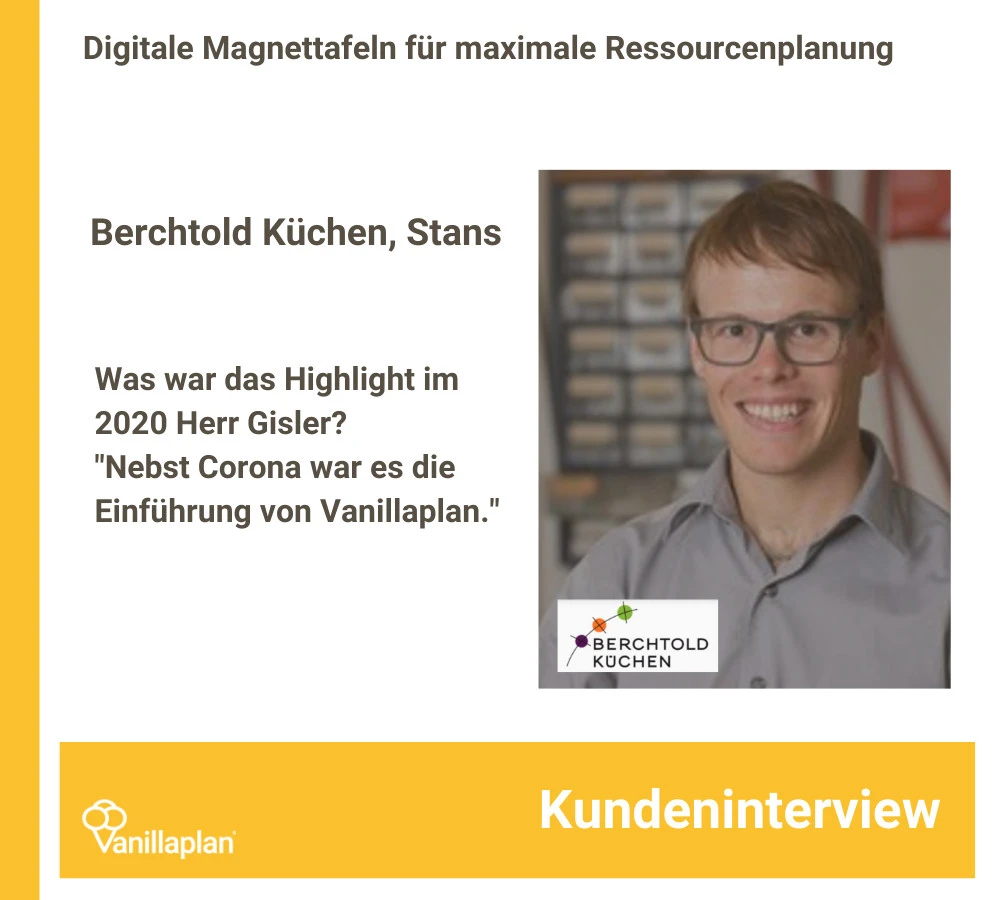
Roger Gisler in interview: the use of Vanillaplan at Berchtold Küchen
Roger Gisler is a qualified technician HF in wood technology and a federally certified works manager. Mr Gisler has overall responsibility for Vanillaplan. Berchtold Küchen has been using Vanillaplan since October 2020.
Mr Gisler, what was the highlight of the past year?
There were two: firstly, we coped well with coronavirus and the challenges that came with it, in our case increased workload. Secondly, the successful introduction of Vanillaplan deserves a mention.
Where did you learn resource planning?
During my further training as a technician HF and federally certified works manager at the Bürgenstock technical college, which is supported by our trade association for joiners, the VSSM.
How did you learn deployment and capacity planning?
Various software companies presented their resource planning solutions. The basics were also taught in the further training. I learned the practical side in our company. I completed a joinery apprenticeship and worked in the trade for a few years. That forms the basis for estimating effort and costing, which is then transferred to resource planning.
Is there further training in this field too?
There is a further training offering from the joiners' association and, as already mentioned, in the training to become a technician and works manager. In addition to the theoretical training, a personal interest in costing and resource planning also counts.
How did you hear about Vanillaplan?
While searching for a suitable digital solution for resource planning, a colleague from our team came across Vanillaplan on the internet and sent me a link. After a brief look at the Vanillaplan website, we soon looked at the demo version.
How did you do resource planning before Vanillaplan?
We planned the assembly workload on paper (similar to magnetic boards) and additionally listed the orders in Excel. Planning assembly on paper made it difficult to correctly schedule the dependencies of production and work preparation (AVOR), which repeatedly led to bottlenecks in production. That is why we wanted to get away from paper and take a new path.
How did getting started with Vanillaplan go?
Getting started with Vanillaplan was a little slow. After we looked at the demo version, the tool was initially rejected. Vanillaplan then got in touch by phone and asked more detailed questions. Following that conversation, we tried again. Assembly planning continued to be done on paper, and in parallel we tested the planning of assembly and two further departments with Vanillaplan.
What were the challenges?
Some employees found it difficult to let go of paper and trust the program. Because of this lack of trust, changes to orders were not entered and updated well enough. Logically, this led to bottlenecks and problems. It was somewhat difficult at the beginning; by now it is going better and better for everyone and we have planning under control.
Who is responsible for resource planning?
Long-term capacity planning is the responsibility of the management and the costing team. In a weekly meeting, capacity and long-term deployment planning are discussed: whether there is room for additional orders or where there may be an overload. In the capacity plan, the upstream departments, production and work preparation (AVOR), are then calculated back from the start of assembly. Our work preparation (AVOR) is responsible for short-term weekly to daily planning, especially for small orders and detailed planning.
How are capacity and deployment planning organised in your business?
At first, resource planning being visible to everyone in Vanillaplan put some employees under pressure. By now, however, everyone has been able to see that when there are bottlenecks, people look out for each other and resources are adjusted accordingly. We created an organisation chart specifically for this, showing who is responsible for what and with which deputies. Meanwhile not only assembly is planned, but three departments in total: work preparation (AVOR), production and assembly. We can imagine adding the surfaces and bench work departments in future.
Besides the person with overall responsibility, three other people are in charge of resource planning.
For a better overview of deadlines, we record the assembly date in the projects under remarks and can thus sort the orders by assembly start. This allows us to export the data to Excel as usual and post it as a list in the departments for everyone to see.
What do you like about Vanillaplan?
The dependencies between the individual work steps and departments, work preparation (AVOR), production and assembly, become much more visible.
The mobile app, which our fitters use, is also very useful. They see not only their own assignments but also those of their colleagues up to 14 days in advance. The fitters can now suggest improvements to their assignments, for example helping each other when jobs are close to one another.
In the break room we have set up a computer that makes the deployment plan visible to everyone. Employees look at their assignments in the daily and weekly plan, so everyone thinks along and contributes additional support and help, which lets the business move forward better in these challenging times.
What is your benefit?
The joined-up thinking of all employees has improved and dependencies are made more visible. As a result there are fewer bottlenecks in production and in the business.
Many thanks for the interview, Mr Gisler.
More information on the website of Berchtold Küchen.