
Hello Remi, many thanks for taking the time for our interview today. In our last articles we looked at the differences between on-prem, private cloud and public cloud. Which model is used at Vanillaplan?
We have software as a service, i.e. the software is organised in such a way that everyone who works with it effectively works on the same instance. So it is basically a public cloud.
OK, what are the advantages of that and why is this model used at Vanillaplan?
The advantages are very varied: first of all, all customers work on the same instance, i.e. at any given time there is only ever one version. That makes maintenance considerably easier and also means that none of the users has to install updates themselves. Since the whole infrastructure is maintained centrally, all the tiresome maintenance work you would otherwise have simply falls away. Beyond that, the security of the data is of course also managed centrally.
That sounds good. You have already hinted at it: what specifically are the advantages for users?
Because the whole infrastructure is organised centrally, it is possible for Vanillaplan to take care of updates, backups and the complete maintenance and upkeep of the software. Since only one installation has to be looked after at a time, the whole thing is enormously simplified and the user does not have to worry about it.
Suppose Vanillaplan were offered as on-prem or private cloud instead of public cloud. Would customers then have to take care of software maintenance themselves, or pay for updates that you or Vanillaplan ultimately carry out?
Yes, essentially that is it. So if it runs in one instance per customer, then each instance would have to be installed, configured and maintained separately - and that would be in the customer's care, whether they do it themselves or commission someone to do it. And I think that multiplies this effort; with the number of installations that also makes for a less favourable cost structure.
So actually for both the customer and Vanillaplan? It is simply less effective?
Exactly.
Those were the advantages; are there also problems - or, if it is all so advantageous, why does not everyone use the public cloud and the software-as-a-service model?
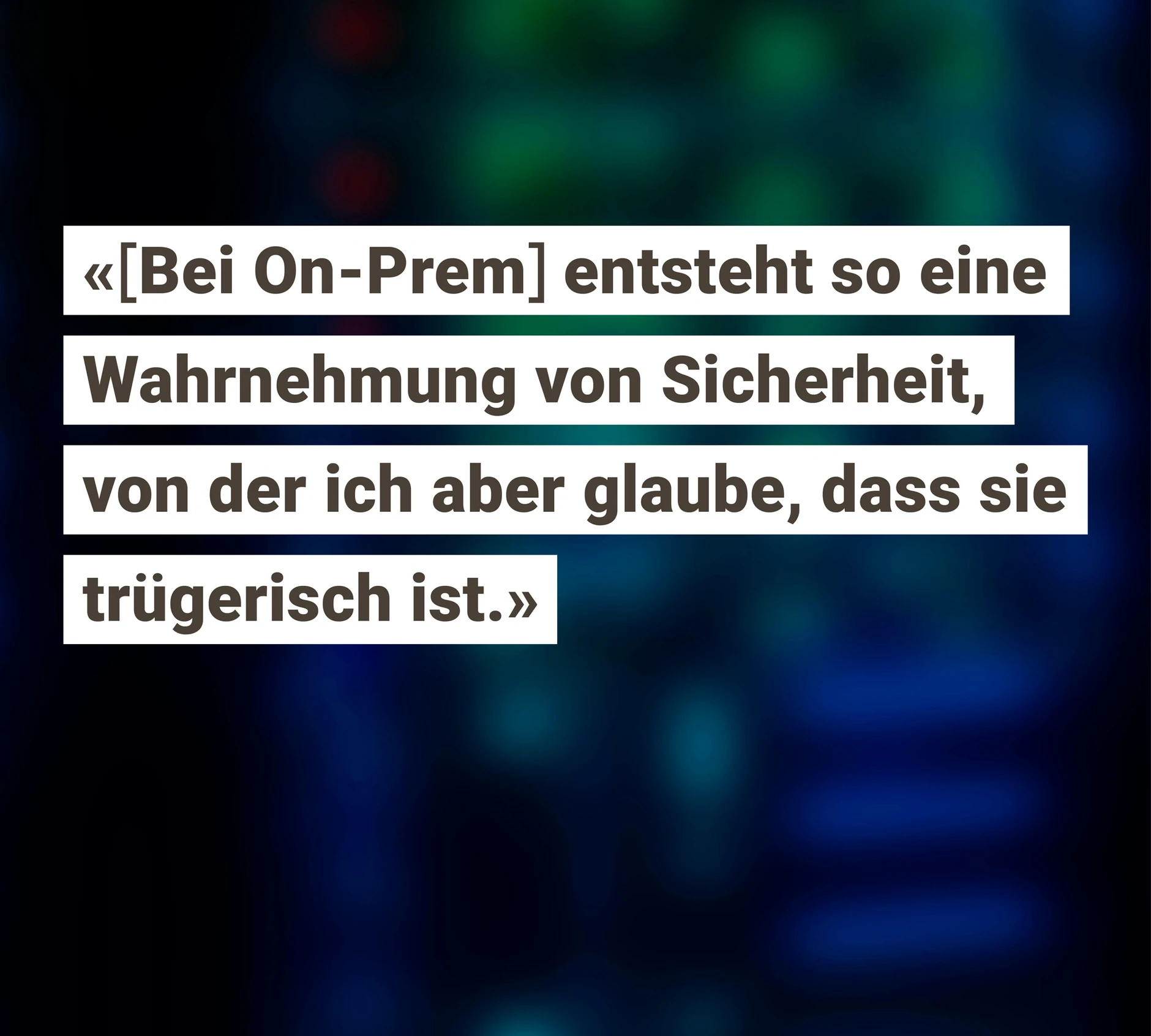
Yes, there are two things. One is that many programs were not built in such a way that they would work in the public cloud. The other is that people are used to software running either on their own computer or at least on the company's own server. They are used to owning the software, as it were, with the data staying with them and not leaving the building. That creates a perception of security which I believe, however, is deceptive. Particularly since cyber attacks have been increasing drastically of late. And I also believe that for a small business that wants to manage it themselves, it is almost impossible to guarantee the same level of security as when the software runs in a managed environment.
So you actually see few advantages, but rather a false sense of security?
Above all I see the false sense of security and the poor cost structure. There are also many people who are inclined towards it and recommend converting from your own IT to the cloud. That applies to simple things like storing and editing files, as you know it from Office 365, for example. Or with Google, where you use email in the cloud. Even telephony today often takes place in the cloud and is of course more favourable in terms of cost structure than having your own telephone system physically in the building.
So from the way you describe it, you actually see the public cloud solution as the technology of the future, and the reason some people are not using it yet lies, in your view, in the fact that they have not yet switched the way they run their software to this format?
Yes, on the one hand it is the end users who have not yet switched to cloud solutions. On the other hand, of course, it is also many software providers, whether in ERP or in construction software. They originally developed their software as monolithic on-prem software, i.e. so that it runs on a server at the company; but that will not prevail in future. Essentially they would have to redevelop their software completely if they want the certainty that the cloud concept and multi-tenancy are really implemented correctly.
Very interesting, many thanks for the interview, Remi!